
Stopped adding sugar to your tea?
Good.
But your breakfast came from a packet.
In lunch you took pickle, papad and packaged curd.
Evening took biscuits.
Dinner ordered from an app.
And dessert labelled “no added sugar.”
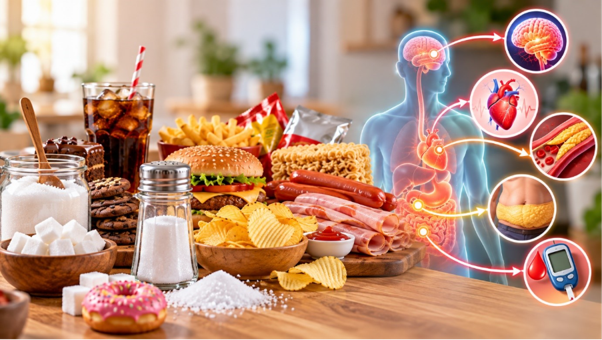
Modern diets contain sugar, salt and highly processed ingredients in places we do not always notice.
That matters because lifestyle diseases are shaped by patterns, not just obvious junk food.
<10% of daily energy
WHO recommends keeping free sugars below 10% of total daily energy, with <5% suggested for additional benefits. World Health Organization
<10% of daily energy
should generally come from saturated fat.
<1%
should come from trans fats. World Health Organization
11 g salt/day
was the estimated global average adult intake in 2021—more than twice WHO’s recommendation of less than 5 g/day.
Food processing itself is not automatically bad.
Milk is processed.
Curd is processed.
Frozen vegetables are processed.
Dal is cleaned and processed.
The concern is more often with foods that combine:
These foods are often easy to eat quickly and hard to stop eating.
Many people think sugar is only in cakes or sweets. Yet, hidden sugars in packaged foods are common
You may use very little salt while cooking.
But sodium also comes from:
This matters particularly for people managing high blood pressure or cardiovascular risk.
Sometimes the salt shaker is not the main problem.
The packet is.
Not all packaged food deserves the same label.
Compare:
The useful question is:
“How close is this food to something I would recognise as an actual meal ingredient?”
Ultra-processed foods are designed to taste good and be easy to eat. Because they are soft, sweet, or salty, you may eat more without feeling full. Studies show that people who eat more ultra-processed foods often eat more calories overall. As a result, this can lead to weight gain and other health problems. Also, these foods are often low in fiber and nutrients
Frequent excess intake of added sugars can contribute to:
But the solution is not to fear every gram of naturally occurring sugar.
Fruit contains sugar.
It also contains fibre, water, vitamins and plant compounds.
A mango is not metabolically identical to a soft drink.
Context matters.
High sodium intake can contribute to elevated blood pressure in salt-sensitive individuals and populations.
Reducing excess sodium can therefore be important for people with hypertension.
But eating less sodium is not simply:
“Do not add salt.”
It is also:
The Health Halo Problem
Sometimes, foods seem healthy but are not. This is called the “health halo” effect.
For example, some snacks are labeled as “low-fat” or “whole grain.” However, they may still have a lot of sugar or salt.
Because of this, it is important to look at the full nutrition label. Even foods that look healthy can add to your sugar and salt intake.
Many people believe millet-based foods are always healthy. However, this is not always true. Some millet snacks and ready-to-eat products are highly processed. For example, they may contain added sugars, salt, or unhealthy oils. According to recent millet health facts, processing can remove fiber and nutrients from millet. Therefore, not all millet foods are good for you. Always check the ingredient list and nutrition label. Choosing whole, unprocessed millet is a better option. This way, you get more fiber and nutrients with fewer additives. A millet label can be a health halo—the overall food still matters more than the marketing claim.
Everyday Food | What to Keep in Mind |
Breakfast Cereal | Some varieties can be high in added sugar. |
Biscuits | Even “digestive” types may contain refined flour, fat, and sugar. |
Packaged Juice | Usually has less fibre than whole fruit. |
Namkeen | Often high in salt and easy to overeat. |
Instant Noodles | Usually high in sodium and low in fibre and protein. |
Sauces | Small amounts can still add significant sodium and sugar. |
The lesson is not:
Never eat them.
It is:
Know what they are and decide how often they belong in your diet.
NutriClinics in your area supports healthy eating. Because every person is different, NutriClinics offers advice that fits your needs. For example, they can help you spot hidden sugars and salt in your diet. They also teach you how to reduce processed food intake. With expert help, you can make better choices every day.
It is not about cutting out all sugar, salt, and processed foods. Instead, focus on how often you eat them. For example, try to eat fresh fruits, vegetables, and whole grains most of the time. When you do eat packaged foods, check the labels. Because small changes add up, you can improve your health without feeling deprived.
If diabetes, high blood pressure, cholesterol, fatty liver or weight concerns have you questioning everything you eat, NutriClinics can help simplify it. Consult our Nutritionists for a personalised plan that shows you what to reduce, what to keep and how to build healthier everyday meals without unnecessary food fear.
👉 Book your heart-health nutrition consultation at NutriClinics today — because your heart deserves more than a generic diet chart.

Tell us about yourself and we'll match you with the right dietitian.